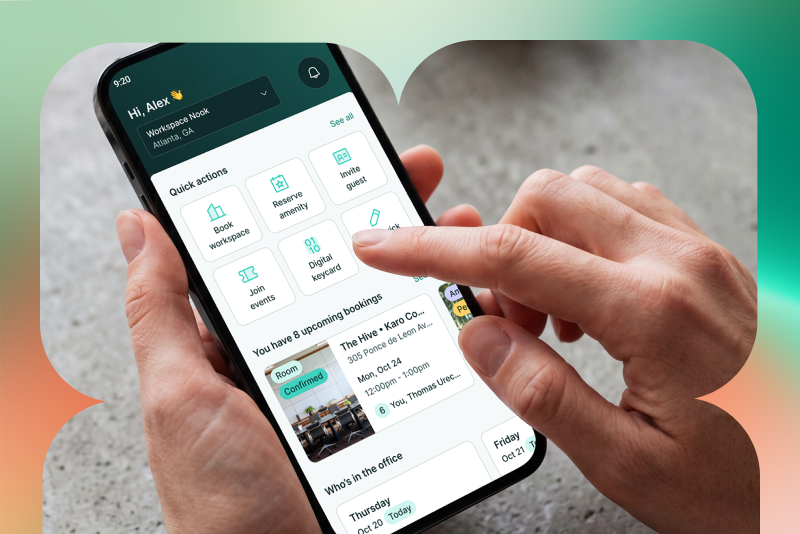


Why Your Tenants Are Rethinking Their Lease — and What You Can Do About It
The true cost of the traditional lease is pushing tenants toward flex. Owners who offer it in-house keep them.
The tenant who signed your office lease is looking at a different number than the one on the term sheet. The asking rent is the entry point. By the time they add fit-out capital, furniture, IT cabling, cleaning contracts, insurance, maintenance reserves, and the cost of carrying space their team doesn’t reliably use, the gap between what they signed and what they’re actually spending can be substantial — and it’s often larger than expected.
In one real-world example from comparing the cost of leased, serviced, managed, and coworking offices, a lease that looked like $4,200 a month landed at nearly $6,800 once build-out, janitorial, parking, and reserves were factored in — a 62% gap between the number on the term sheet and what actually hit the P&L.
Your tenants know this. And increasingly, they’re running the math on alternatives.
” The predominant theme in the near and intermediate future for occupiers’ long term real estate strategy is still the same – uncertainty. With this, offering flexible terms in a variety of sizes and options is seemingly the sweet spot. ”
– Sagar Morabia, Vice President at Yardi.
The implication is straightforward: if your property’s value proposition is built entirely around fixed, long-term commitments, it is also built around a single point of failure. If you’re retaining and attracting tenants in this market, it’s because you’re already building flexibility into the building itself.
A Quick Note on Terminology
This article references several flexible workspace models. For clarity:
- Coworking is shared workspace operated by a third party, available on flexible terms. Pricing typically falls into two models: on-demand (booked by the hour, day, or week with no ongoing commitment) and subscription-based (a recurring monthly membership with a dedicated desk or a set number of days per month).
- Managed and serviced offices are private, fully fitted suites operated by a third party on 12- to 36-month terms, offering more privacy and customization than coworking but shorter commitment and lower capital exposure than a traditional lease.
What Your Tenants Are Actually Paying
The gap mentioned earlier breaks down into three categories of cost that don’t show up in the lease abstract, but routinely determine whether a tenant renews or walks.
Capital exposure
Fit-out costs that can exceed $150 per square foot before furniture and technology according to Cushman & Wakefield’s Global Trends in Flexible Office 2025, running $1.5M to $2.1M for a 10,000-square-foot space before anyone sits down.
Operating risk
The cost of carrying space that headcount no longer justifies, or the penalties for exiting early.
Utilization drag
Paying full price for capacity that sits half-empty. These are the costs that determine whether a tenant renews, and they help explain why prime office occupier costs rose year over year through Q4 2025, according to Savills’ Global Occupier Markets report.
The Three Models Your Tenants Are Comparing
When a lease comes up for renewal, tenants are weighing three alternatives, and increasingly, they’re not choosing just one:
Flexible Workspace
Flexible workspace bundles space, utilities, cleaning, IT, and furniture into a single per-seat fee with no fit-out capital and no exit penalty. With over 9,000 locations and 163.9 million square feet across the U.S., tenants in virtually any metro can find a credible alternative. Flex isn’t unconditionally cheaper — at high densities and long horizons, a well-negotiated lease often wins on cost-per-seat — but the premium buys optionality your tenants are pricing more seriously than ever.
Managed and Serviced Offices occupy the space between a standard coworking membership and a conventional lease. The operator fits out and furnishes a private suite; the tenant takes it on a 12-to-36-month agreement and pays a bundled per-seat rate that covers space, utilities, cleaning, and most IT.
The key distinction from coworking is privacy: managed offices function as the tenant’s own space, without the shared-floor dynamic. For teams of 15–75 that need dedicated, branded space without a multi-year capital commitment, this is often the best total-cost outcome.
Leasing Elsewhere
The second alternative is straightforward: your tenant moves to another traditional lease.
This is typically driven by downsizing after a headcount reduction, relocating closer to a distributed workforce, or finding better terms in a tenant-favorable market. The TCO math follows them — a t the national average asking rate of $33 per square foot according to CommercialCafe’s April 2026 office report, and 165 square feet per person per JLL’s 2025 Global Occupancy Planning Benchmark, a 10-person team pays roughly $4,125 per month in base rent alone. Layer in CAM charges, TI repayment, fit-out, furniture ($15–40/sqft), IT ($10–25/sqft), cleaning and utilities ($8–15/sqft annually), and early termination exposure. Under ASC 842 and IFRS 16, those commitments also land on your tenant’s balance sheet — another factor pushing them toward flex alternatives structured as pure operating expense. Ownership
Ownership remains rare; the capital and operational complexity are prohibitive unless real estate is core to the business.
Of these three alternatives, flexible workspace is the one reshaping the competitive landscape most rapidly — and the one you can directly address within your own building.
Flexible workspace currently accounts for roughly 3% of total U.S. office inventory, according to JLL, but the trajectory is steep: JLL projects that 30% of office space will be consumed flexibly by 2030. The gap between where the market is today and where it’s heading represents both a competitive risk and a revenue opportunity.
The drivers extend beyond the hybrid work transition, which has largely stabilized. Broader workforce shifts — including ongoing restructuring across white-collar industries and the early effects of AI on headcount planning — are making it harder for organizations to commit to long-term space requirements with confidence. As JLL’s April 2026 analysis puts it, AI is creating “ uncertainty around long-term workforce composition and headcount forecasting, ” making portfolio flexibility a core real estate imperative rather than a tactical add-on.
For building owners, this means the flex share of total office space is growing whether you participate or not. The question is whether that growth happens inside your building — generating revenue and strengthening tenant relationships — or at a coworking location down the street.
How the Costs Actually Stack Up
The table below illustrates how the cost components compare across a representative 50-person team requiring dedicated workspace in a single market. Numbers are directional ranges based on current market data.
| Cost Component | Flexible Workspace | Managed / Serviced Offices | Leasing Elsewhere (5–10 yr) |
|---|---|---|---|
| Base occupancy cost (per seat/year) | $3,500–$9,000 | $5,500–$12,000 | $6,000–$15,000 |
| Fit-out capital (amortized, per seat) | $0 | $0 | $6,000–$18,000 |
| Furniture & equipment (amortized) | $0 | $0 | $1,500–$4,000 |
| Utilities & cleaning (annual/seat) | Included | Included | $600–$1,200 |
| IT infrastructure (amortized) | Mostly included | Mostly included | $800–$2,000 |
| Maintenance & property mgmt | Included | Included | Partial (CAM) |
| Exit / termination exposure | Low–None | Low–Medium | Medium–High |
| Utilization risk (at 60% occupancy) | Partial–None | Partial | Full |
| Balance sheet treatment (ASC 842) | OPEX | Typically OPEX | ROU asset + liability |
| Effective cost range (per seat/year) |
$3,500–$9,000 | $5,500–$12,000 | $15,000–$41,200 |
Note: Managed office rates reflect fully fitted private suites on 12–36 month terms. Serviced office national median is approximately $456 per desk per month ($5,472/seat/year), anchoring the bottom of the Managed/Serviced range. Coworking rates reflect hot desk to dedicated desk memberships. Private office coworking sits between the two.
The effective cost range for flex looks compelling until you account for the density ceiling: coworking rates are per-seat rather than per-square-foot, and at very high team densities the cost advantages compress. For a 200-person team in a single building, a well-negotiated lease almost always wins on raw cost. For a 50-person team distributed across four cities, flex wins decisively.
This is your competitive landscape. The buildings that can offer multiple models under one roof are the ones that match how tenants actually want to buy space. Utilization Risk: The Variable That Changes Everything
According to JLL’s 2025 Global Occupancy Planning Benchmark Report, North American office utilization averaged just 48% in 2025, which is well below the 79% target most organizations set for themselves. Space costing $80 per square foot per year and sitting half-empty costs $160 per used square foot. That’s the number your tenants’ CFOs are watching, not the asking rent.
”Organizations negotiate against asking rent, but the number that actually matters is what tenants are paying per seat that’s reliably occupied. At 48% average utilization, a lot of companies are carrying costs they haven’t fully priced. When you can surface that data and offer alternatives within the building itself, you’re in a much stronger position to retain those tenants.”
– Sagar Morabia, Vice President at Yardi.
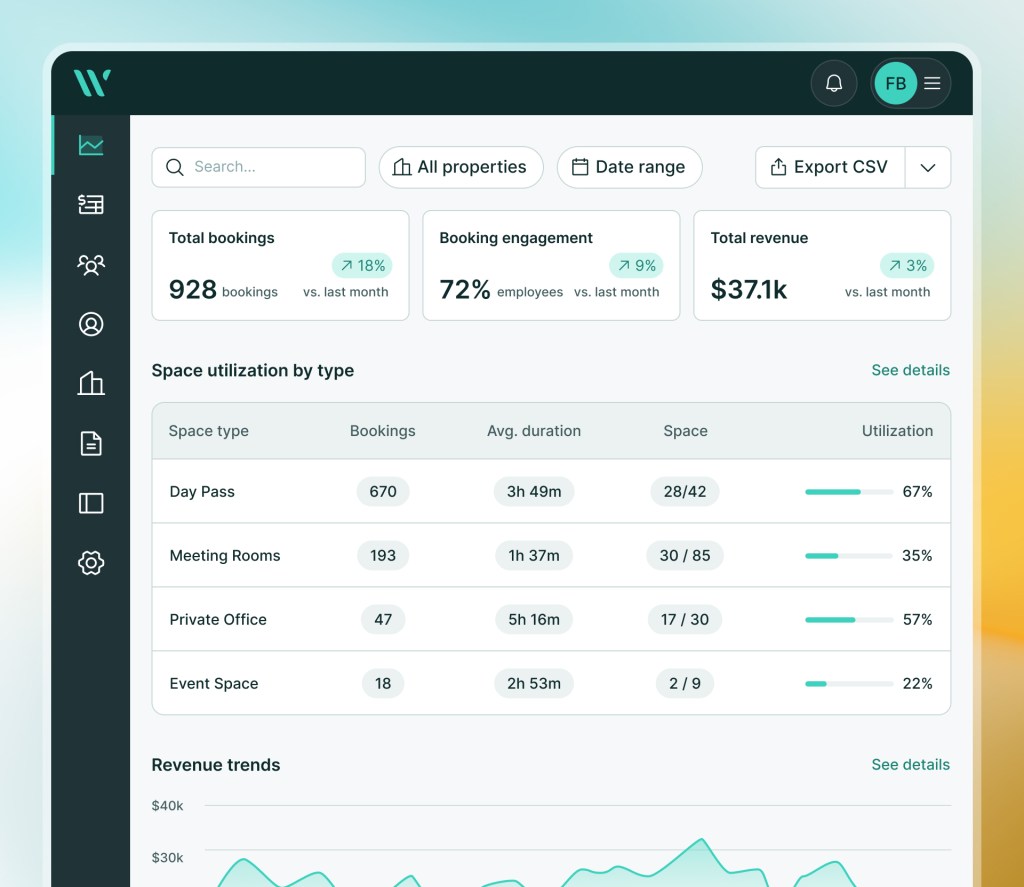
Flexible workspace transfers most of that risk to the operator. Month-to-month or 12-month terms let teams right-size without penalty. The monthly rate may be higher, but tenants aren’t paying for space they’re not using. Buildings that let tenants flex within the property itself, rather than forcing them to go elsewhere to find that flexibility, are the ones that retain them.
Workforce Geography: Where the Flex Argument Gets Stronger
The traditional lease model assumes a team that works in one place. Increasingly, that assumption doesn’t hold. When tenants’ teams are distributed across multiple cities — through remote hiring, hub-and-spoke expansion, or acquisition — the case for flexible workspace as a portfolio layer strengthens considerably.
Signing leases in five cities to accommodate 8–15 employees each is capital-intensive, operationally complex, and creates exit risk in every market. A coworking network with a consistent membership structure lets those tenants establish professional workspace in multiple markets without the anchor of a long-term commitment in each one.
Research on the fastest-growing U.S. metros reinforces this: secondary markets where workforce growth is outpacing traditional office supply are precisely where flex inventory has expanded most aggressively. For companies following talent into cities like Austin, Nashville, Raleigh, and Salt Lake City, flex operators are already established.
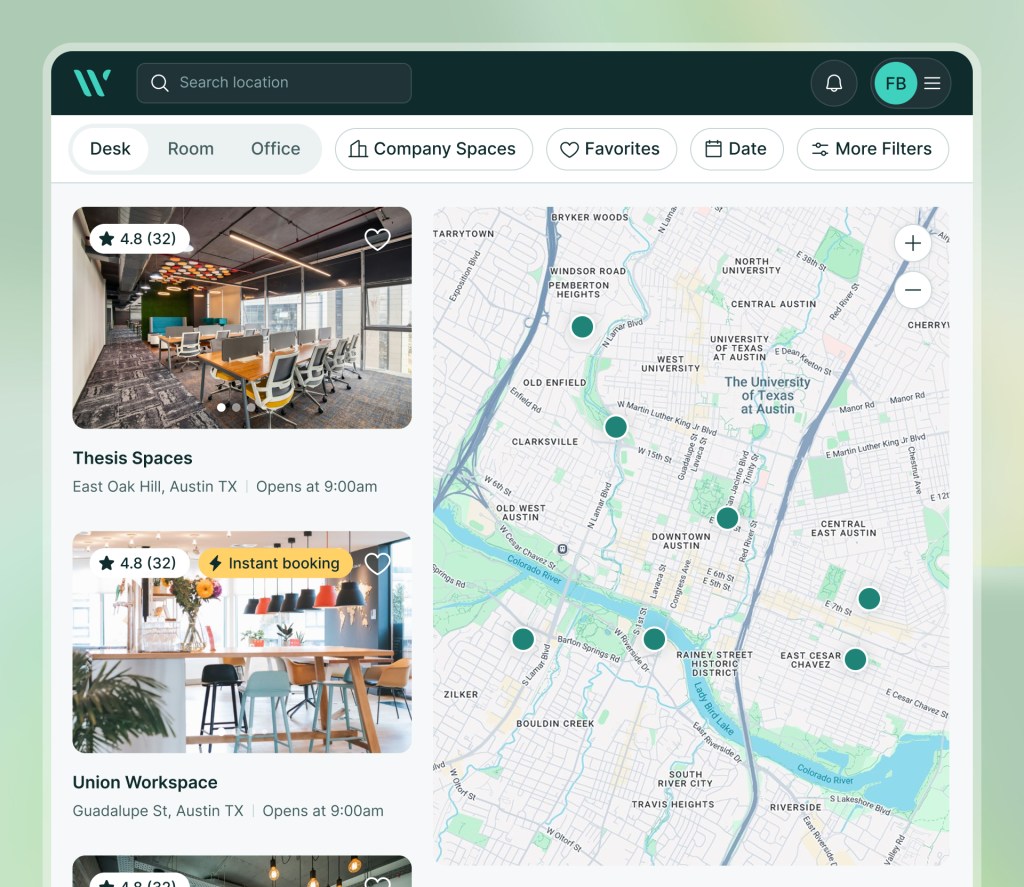
For building owners, the strategic question is: can your property serve as the anchor in that distributed model? If a tenant’s headquarters is in your building but their satellite teams are booking desks elsewhere through a platform your building doesn’t connect to, you’re missing a retention lever. If your building offers the hub experience and connects tenants to a broader flex network through a single platform, you become the center of their workspace strategy rather than just one node in it.
Your Opportunity: Not Either/Or
The most sophisticated tenant organizations are deploying a blend — anchor offices where density justifies the commitment, flex as the variable layer for everything else. CBRE research confirms the crossover sits around 50 seats: below that, flex is almost always cheaper; above it, a well-negotiated lease typically wins. And according to Cushman & Wakefield’s Global Trends in Flexible Office 2025 report, more than half of occupier executives globally now include flex space as part of their workplace strategy. This shift doesn’t have to mean losing tenants to third-party flex providers. It can mean offering that flexibility inside your own building — capturing the revenue, strengthening the tenant relationship, and making your property the platform tenants build their workspace strategy around. The challenge is operational.
Running a Building Takes Too Many Systems
Most buildings today run tenant experience and operations on separate platforms. The gaps between them are where money and time leak out.
Tenant requests arrive by phone and email, then get rekeyed by your team. Amenity and event revenue doesn’t land cleanly in core accounting. You invest in tenant experience to differentiate, but without operational delivery behind it, the ROI never materializes. And the data you need to understand tenant health — engagement, utilization, financials — lives in three different tools that don’t talk to each other.
Most tenant experience platforms try to bridge this by sitting on top of your property management system and syncing a copy of your data. That creates a second source of truth, middleware to maintain, and the persistent risk of what the tenant sees drifting from what your operations team is working from.
” The question isn’t whether to offer a modern tenant experience, but whether the platform delivering it runs on your actual property data or a synced copy of it. When experience, operations and finance share the same database, every booking, service request, and amenity charge flows straight through to your ledger. That’s where the ROI is. ”
– Sagar Morabia, Vice President at Yardi.
WorkCafe is Yardi’s tenant experience and building operations platform, built natively inside Voyager. Not bolted on. Not synced. Built in.
To be clear: WorkCafe doesn’t turn you into a coworking operator or convert your traditional leases into short-term agreements. Your lease business stays exactly as it is. What WorkCafe does is let you monetize the space that’s already sitting underused (an empty conference room, a vacant floor, unassigned parking spots) by making it bookable on flexible terms: hourly, daily, monthly, per desk, etc.
For your tenants, it’s a branded app — white-labeled to your building — where they book meeting rooms and shared spaces, register and check in guests, submit service requests, and stay connected to building news and events. For your team, it’s a single operational dashboard where every visitor, booking, amenity charge, and service ticket is managed in one place, on live Voyager data.
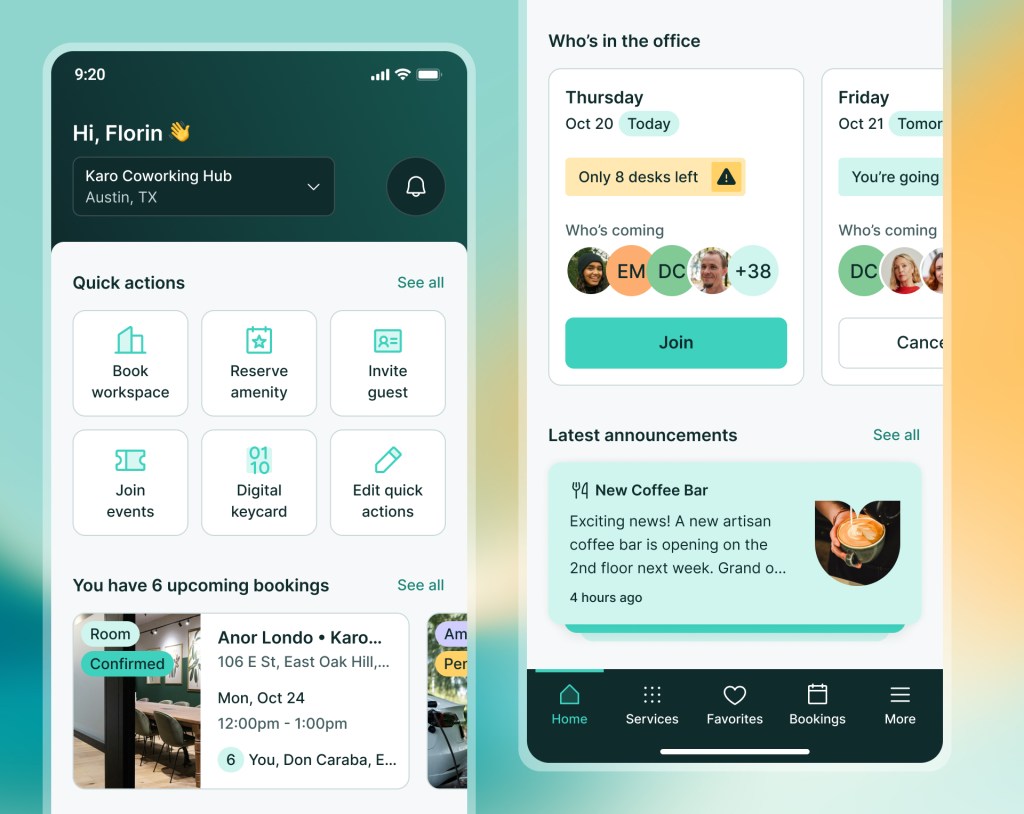
The revenue opportunity is specific: meeting rooms, event spaces, gym access, parking, EV charging — underused spaces in your building that aren’t generating revenue today become bookable, billable inventory that tenants and outside users can reserve in a tap. Those charges flow directly into Voyager’s accounting without manual reconciliation or billing gaps.
Because WorkCafe runs on the same Voyager database your accounting and leasing teams already use, there’s no middleware to maintain, no data to reconcile, and no additional system to secure. Tenant activity — bookings, service requests, visitor logs, amenity charges — connects to your existing tenant and lease records from the start.
Assessing Your Tenant Base: Five Questions That Flag Retention Risk
The lease-own-flex decision is, at its core, a portfolio construction problem — and your tenants are already working through it. These five questions can help you identify which tenants are most likely to need flexibility, and where your building can meet them:
How stable is their headcount?
Tenants whose best-case and worst-case headcount projections differ by more than 20% over the next 36 months are the ones most likely to need flexibility — and most likely to look elsewhere for it if your building doesn’t offer it.
Are they concentrated or distributed?
A tenant with one team in one metro can justify a long-term lease. A tenant with teams in three or more cities is already pricing flex seriously. If your building can connect them to a broader flex network, that’s a reason to stay.
Where does your market sit?
In tenant-favorable markets with meaningful TI allowances and below-market rents, the flex premium compresses — your lease terms may be competitive enough on their own. In landlord-favorable markets, tenants feel the cost pressure more acutely, and flex becomes a more attractive alternative.
What does their utilization actually look like?
If a tenant’s average daily attendance is below 60% of capacity, they’re subsidizing vacancy. Their effective cost per occupied seat is materially higher than the number in their lease abstract. Buildings that can surface that data and offer right-sizing options have a meaningful edge at renewal.
What’s their exit exposure?
Tenants carrying early termination penalties exceeding 18 months of rent equivalent have a flexibility problem embedded in their portfolio. These are the highest flight risk at renewal — and the most receptive to an in-building flex option.
Your tenants will keep running this analysis. The question is whether your building gives them a reason to stay. Not just with competitive lease terms, but with the operational infrastructure that makes your property the easiest, most connected place for their teams to work.

Balazs Szekely
View more from
Balazs