
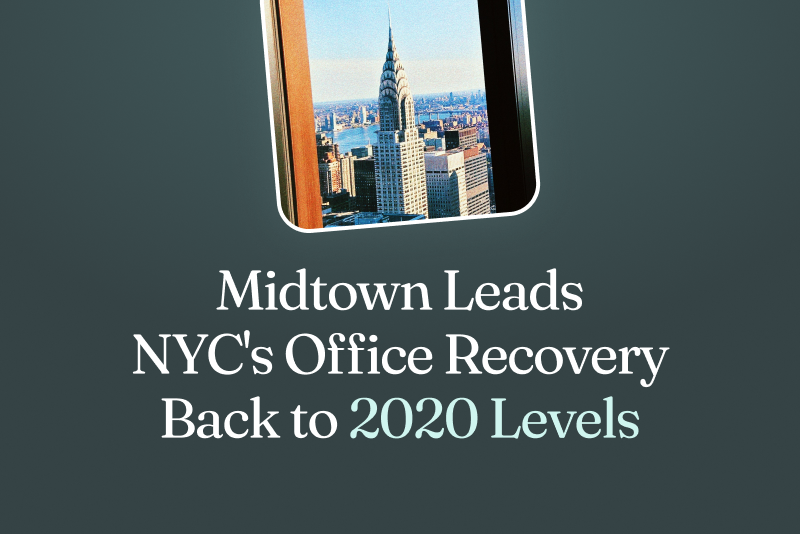
Midtown Leads NYC’s Office Recovery Back to 2020 Levels
After closing more than 10M square feet this summer alone, Manhattan is the first New York City submarket to erase its pandemic-era occupancy losses.
Midtown has become the first New York City submarket to erase its pandemic-era occupancy losses. Colliers data shows the submarket’s available space shrinking to 27.7M square feet by the close of the third quarter — the same level recorded in March 2020. The broader borough showed no sign of the usual summer lull, closing more than 10M square feet of deals and tracking toward its busiest year since 2000.
“The Manhattan office market’s recovery continued at a rapid pace throughout the summer and into the early days of autumn,” Colliers Executive Managing Director of Research and Business Development Franklin Wallach said in a statement.
As space has grown scarcer, pricing has climbed. Midtown’s availability rate slipped to 11.9%, and tenants are now paying an average of $85.08 per square foot, a 5.4% increase from a year earlier — the steepest third-quarter rent gain the submarket has posted since 2014. The squeeze has given Class-A landlords across Manhattan room to raise asking rents to a record $85.45 per SF, with overall availability easing to 12.4% over the July-to-October stretch. Proskauer Rose supplied the quarter’s standout deal, expanding by 478K square feet at 11 Times Square.
“Rents are rising across the board,” SL Green Director of Leasing Steven Durels said at the Bank of America Global CEO Real Estate Conference last month. “They’re not limited to just the high-end part of the market.”
Much of this recovery traces to artificial intelligence firms, which absorbed close to 1.1M square feet of Manhattan space in the quarter — more than they took in Q2 (800K square feet) or across all of 2025 (790K square feet). The appetite is part of a wider shift: AI companies now represent more than half of all technology, advertising, media and information leasing in the country’s largest markets, and New York has claimed roughly 38% of that national activity on its own.
With demand running hot and office buildings steadily being reworked into housing, the long stretch of ever-sweetening tenant incentives appears to be winding down, handing leverage back to owners.
“As we enter the final quarter of the year, the market is beginning a new chapter after achieving several critical recovery milestones,” Wallach said.

Adelina Nicoara
View more from
Adelina